
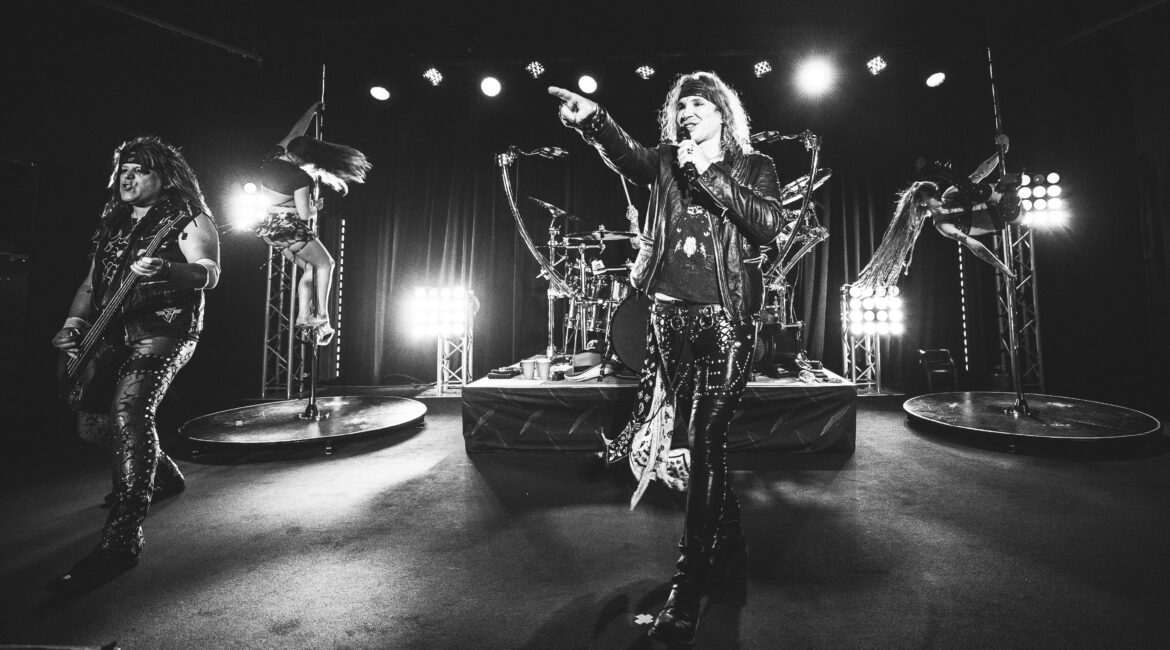
Photos and Review by Ilya Mirman
At the Six String Grill & Stage in Foxborough, the night did not unfold so much as it unraveled with intention. The room carried that familiar electric haze of anticipation—half theater, half confession booth—where the audience already knows the nature of the performance and comes not to be surprised, but to be confirmed in its expectations.
Steel Panther arrived not as guests upon the stage, but as if they were reclaiming it from decorum itself.
Spyder, stationed at bass, held the low end like a man both amused by and complicit in the chaos. He played with an easy authority, the kind that suggests nothing here is accidental, though everything pretends to be. His presence was grounding in the strangest sense—like an anchor tossed into a storm that enjoys being a storm.
Satchel, by contrast, seemed to treat the guitar not as an instrument but as an argument—one he intended to win regardless of logic. His playing carried that peculiar blend of precision and mockery, where technical brilliance is displayed so openly it becomes theatrical. At times he appeared less a musician than a commentator on musicianship itself, and yet the commentary was so flawless it defeated its own irony.
Stix Zadinia commanded the drums with a kind of exuberant discipline, as though rhythm were both law and joke simultaneously. Every strike carried a sense of punctuation—sharp, declarative, and slightly mischievous. He did not merely keep time; he toyed with it, stretched it, and returned it intact, as if nothing had happened at all.
And at the center stood Michael Starr, whose voice and presence held the room in a peculiar suspension between satire and sincerity. He delivered each lyric with the confidence of someone who understands the performance is larger than belief. There is a curious effect in such a persona: the more exaggerated the world he describes, the more stable his authority becomes within it.
The evening began in familiar invocation, with “Eyes of the Panther,” where the band established its familiar language of excess, irony, and theatrical confidence. The crowd responded not as outsiders but as participants in a ritual they had long since agreed to take seriously only in performance, never in principle.
From there, the set moved through its familiar catalog of indulgence and parody: “Tomorrow Night,” “Asian Hooker,” and “Just Like Tiger Woods,” each delivered with the band’s characteristic refusal to acknowledge any boundary between humor and embodiment. These songs are not so much narratives as exaggerated gestures toward narrative—stories told in neon ink, deliberately unstable, yet strangely cohesive in their own logic.
“Friends With Benefits” and similar numbers extended this tension, where suggestion becomes structure and absurdity is treated with the same musical seriousness as melody. Satchel, throughout, seemed to conduct an ongoing private conversation with the idea of virtuosity itself—demonstrating it, distorting it, and then casually surpassing it.
A particular shift occurred during the extended guitar passages, where the performance briefly opened into something resembling reflection—though never fully surrendering its comic framing. It is in these moments that the band reveals its most unusual quality: beneath the satire lies genuine musical craft so assured it refuses to remain merely a joke.
“Death to All but Metal” arrived as a kind of communal declaration, the room collapsing into unified response, as though irony had momentarily agreed to step aside in favor of shared release. Stix drove the piece forward with relentless clarity, each strike reinforcing rather than complicating the momentum.
Later pieces such as “Poontang Boomerang,” “17 Girls in a Row,” and “Community Property” carried the evening deeper into its established paradox: that exaggeration, when sustained with enough precision, begins to resemble its own reality. The audience laughed, but with the ease of recognition rather than surprise.
A striking feature of the performance was the presence of two poles upon the stage, each occupied by dancers who moved with deliberate elevation above the band’s already heightened world. These figures did not interrupt the performance so much as extend it vertically, introducing a visual rhythm that mirrored the music’s own oscillation between grounding and excess. The effect was not distraction but amplification, as though the stage itself had acquired a second dimension of expression.
By the time “Gloryhole” closed the set, the evening had fully settled into its own logic. What began as parody had long since become its own ecosystem—self-aware, exaggerated, yet executed with such precision that it resisted dismissal. The final notes did not conclude so much as dissolve, leaving behind the familiar afterimage of spectacle: loud, knowing, and strangely coherent.
When the lights rose, there was a moment in which the room seemed unsure whether it had witnessed a concert, a satire, or a kind of controlled disorder pretending to be both. And perhaps that uncertainty was the point—not confusion, but suspension.