
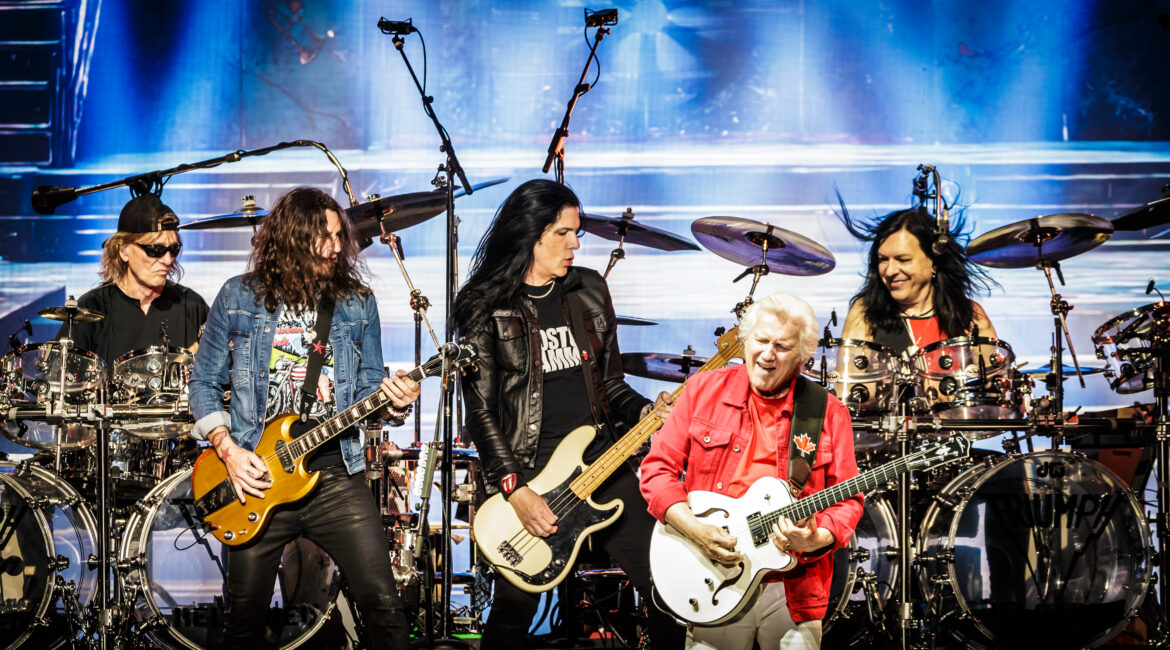
Leader Bank Pavilion, Boston, MA — June 6, 2026
Photos and Review by Ilya Mirman
Galleries: Triumph, April Wine
Some reunions feel obligatory. Others feel miraculous.
Triumph’s return to Boston on Saturday night at Leader Bank Pavilion belonged firmly in the latter category.
Just two days after thrilling fans during a June 4 appearance, the Canadian rock legends rolled back into town with the confidence, firepower, and sheer joy of musicians who understand exactly what their songs mean to generations of fans. The sold-out waterfront venue became a time machine for thousands who had spent decades waiting to hear these songs live again — and Triumph rewarded that loyalty with a performance that felt less like a nostalgia trip and more like a celebration of enduring rock-and-roll craftsmanship.
The evening opened with a palpable sense of anticipation. As fans settled in to their seats overlooking Boston Harbor, conversations revolved around memories of vinyl records, arena shows, and songs that had become the soundtrack to countless lives. By night’s end, those memories had gained a few new chapters.
Before Triumph took the stage, fellow Canadian rock veterans April Wine delivered a set that perfectly established the evening’s tone. More than simply an opening act, April Wine felt like an essential part of the celebration, reminding the crowd just how deep and influential Canada’s classic-rock legacy remains. Their performance was packed with familiar favorites, strong musicianship, and the easy confidence that comes from decades on the road. By the time they left the stage, the audience was fully engaged, creating the ideal runway for Triumph’s arrival and turning the night into a showcase of two of Canada’s most enduring rock institutions.
What made the concert especially compelling was how alive the music felt.
Many classic-rock reunions rely heavily on sentiment. Triumph certainly benefited from the emotional connection fans have with its catalog, but sentiment alone doesn’t carry a two-hour concert. What carried this show was musicianship.
At the center stood Rik Emmett. Decades after helping establish Triumph as one of North America’s premier hard-rock bands, Emmett still commands a stage with a rare combination of technical brilliance and genuine warmth. His guitar work throughout the evening was dazzling without becoming self-indulgent, weaving together soaring leads, intricate fills, and muscular riffs that reminded everyone why he’s long been regarded as one of rock’s most accomplished players.
Just as impressive was his voice. Rather than sounding like an artist fighting time, Emmett sang with confidence and conviction, connecting effortlessly with an audience eager to sing every word back to him.
If Emmett provided much of the melodic heart, Gil Moore supplied the engine.
The drummer and vocalist remains one of classic rock’s most underrated forces, and Saturday’s performance offered a powerful reminder of why. Behind the kit, Moore drove the music with energy and authority. Stepping to the microphone, he delivered vocals that retained the passion and power that helped define Triumph’s sound from the beginning. More than anything, Moore looked genuinely thrilled to be there, and that enthusiasm spread through the venue.
Supporting the founding members was a touring ensemble that felt uniquely suited to carrying Triumph’s legacy forward.
Todd Kerns, the veteran Canadian bassist and vocalist best known for his work with Slash featuring Myles Kennedy & The Conspirators, proved a natural fit. Like Triumph, Kerns emerged from Canada’s rich rock tradition, and his performance demonstrated both respect for the material and an understanding of what makes it work. Throughout the evening he delivered powerful bass lines, strong vocal support, and the kind of effortless stage presence that comes from decades of performing at the highest level. His contributions added muscle and momentum to every song.
Behind the drums, fellow Canadian Brent Fitz brought an equally impressive résumé. Known for his work with Slash, Theory of a Deadman, and numerous major touring acts, Fitz attacked the material with precision and power. His playing added fresh energy without sacrificing the feel that longtime fans expect from Triumph’s catalog. Whether driving hard-rock anthems or navigating more dynamic moments, Fitz supplied the pulse that kept the evening charging forward.
Then there was Phil X, another proud Canadian rock export whose own history made him an especially fitting addition to the Triumph family. Long before becoming known worldwide as Bon Jovi’s guitarist, Phil X had built a reputation as one of rock’s most electrifying players. On Saturday night he approached Triumph’s material with equal parts respect and exuberance.
The result was spectacular.
Rather than attempting to mimic anyone, Phil X celebrated the songs while injecting them with his own unmistakable personality. Every solo seemed to raise the energy level another notch. Whether unleashing blistering runs, soaring melodic phrases, or arena-sized riffs, he played with the enthusiasm of a lifelong fan who couldn’t quite believe he was standing onstage performing this music.
What made his performance particularly effective was the chemistry he shared with Emmett. Rather than competing for attention, the two guitarists complemented one another beautifully, creating some of the evening’s most memorable moments.
Together, Emmett, Moore, Kerns, Fitz, and Phil X formed a lineup that felt less like a replacement cast and more like a continuation of a distinctly Canadian rock legacy.
As the set unfolded, the crowd responded with growing enthusiasm. Familiar riffs triggered immediate cheers. Choruses became massive sing-alongs. Fans who had waited years — and in some cases decades — to hear these songs performed live again embraced every opportunity to participate.
The Triumph catalog has always occupied a unique place within classic rock. The band combined the technical sophistication of progressive rock with the direct emotional impact of arena anthems. They could be ambitious without becoming inaccessible, virtuosic without losing sight of melody. Those qualities remain remarkably intact.
The setlist showcased virtually every side of the band’s legacy. The uplifting optimism of “Hold On,” the hard-driving power of “Lay It on the Line,” the crowd-pleasing singalong of “Fight the Good Fight,” and the triumph of “Rock & Roll Machine” all landed with tremendous impact. Rather than feeling like artifacts from another era, the songs sounded vibrant and immediate, reminding everyone why they became staples of rock radio in the first place.
Song after song demonstrated why Triumph’s music has endured. The arrangements sounded expansive and powerful. The melodies remained instantly memorable. The musicians attacked every number with enough conviction to make the material feel fresh rather than preserved.
The setting added another dimension.
As darkness settled over Boston Harbor and the city skyline illuminated the backdrop, Leader Bank Pavilion felt tailor-made for an evening like this. The combination of waterfront views, summer air, and classic-rock anthems created an atmosphere that bordered on cinematic. Few venues in New England offer a more picturesque setting, and Triumph took full advantage of it.
Perhaps most importantly, the evening carried an unmistakable sense of gratitude.
The band appeared genuinely appreciative of the audience’s loyalty. The audience, in turn, seemed determined to savor every moment. That mutual appreciation transformed the concert from a simple performance into something more meaningful — a celebration of longevity, friendship, and the enduring bond between artists and fans.
The best reunion concerts don’t attempt to recreate the past.
They remind audiences why the past mattered in the first place.
Triumph accomplished exactly that.
Led by the enduring talents of Rik Emmett and Gil Moore — and strengthened by the outstanding contributions of fellow Canadian rock veterans Todd Kerns, Brent Fitz, Phil X, and the rest of the touring band — Triumph transformed Leader Bank Pavilion into a celebration of everything that makes classic rock endure.
The songs sounded massive. The musicianship was impeccable. The crowd never stopped singing.
For one unforgettable night on Boston’s waterfront, the Rock & Roll Machine wasn’t merely restarted.
It was running at full speed.