
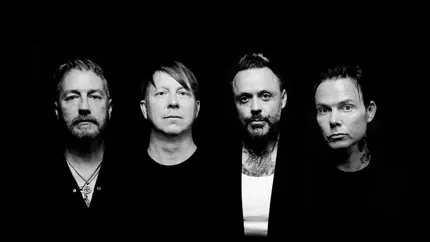
Twenty years after Foiled turned heartbreak into alternative-rock anthems, the Blue October frontman revisits the album that changed everything—and explains why the songs sound different when you’re finally at peace.
By Ilya Mirman
Twenty years ago, Justin Furstenfeld was trying to make the album that might save his career. Today, he’s dreaming about spending a couple of years traveling the country in a camper van, writing, painting, and enjoying the quiet. Somewhere between those two ambitions lies the remarkable evolution of Blue October’s frontman—a songwriter whose deeply personal music has connected with millions of listeners, and who now finds himself revisiting the darkest chapters of his life from a place of unexpected contentment.
In 2006, Blue October released Foiled, the platinum-selling album that transformed the Texas alternative-rock band from a cult favorite into a mainstream success. Its breakout singles, “Hate Me” and “Into the Ocean,” became fixtures of mid-2000s alternative radio, introducing a much wider audience to Furstenfeld’s distinctive combination of confessional lyrics, soaring melodies, and atmospheric arrangements. Now, with Blue October celebrating the album’s 20th anniversary on tour, including a November 13 stop at Citizens House of Blues in Boston, Furstenfeld is performing those songs again—not as a young man consumed by the emotions that inspired them, but as an artist who has spent two decades learning what they mean. And perhaps most remarkably, he doesn’t hear the same songs anymore.
The Album That Changed Everything
By the time Blue October began work on Foiled, the stakes were high. The band had already endured its share of record-industry turbulence, and Furstenfeld knew he had another opportunity to deliver something meaningful for Universal Records. But instead of chasing the prevailing trends of 2005, he made a counterintuitive decision: trust his instincts. “I knew that we had one more chance to make something for a huge corporate label like Universal Records,” he recalls. “And I knew what my job had to be.” He understood the commercial expectations, but refused to let them dictate the music. “If they’ve invested all this money into my brain and my heart, then I should trust my heart,” he explains.
Looking back, he recognizes a creative freedom that might be harder to summon today. The younger Furstenfeld wasn’t obsessing over three-minute song lengths or precisely engineered hooks. He was following his emotions wherever they led. “Back then it was just, my heart’s broken and I need to talk about it.” He flew to Los Angeles carrying years of musical fragments, late-night demos, and ideas that had been accumulating in his head. The result would be an album that drew from an extraordinarily eclectic collection of influences: The Cure, Cocteau Twins, Radiohead, Pink Floyd, The Smiths, Michael Jackson, George Michael, Kanye West, and Peter Gabriel. Furstenfeld describes the process with the enthusiasm of someone who still finds the act of making music almost impossibly exciting. He wanted to approach music the way Willy Wonka approached candy-making—combining unexpected ingredients and allowing his imagination to run wild. It wasn’t about copying any of those artists, but blending their musical DNA into something unmistakably his own.
One of the most revealing moments of our conversation comes when Furstenfeld explains how Foiled actually took shape. Before the album existed, there were beats, samples, and small melodic ideas recorded in his bedroom, often late at night when nobody else was around. One particular rhythm fascinated him. He listened to it while driving for nearly two years, and somehow it never became tiresome. “This beat is never getting old,” he remembers thinking. “And I listen to it every day.” That realization became an organizing principle for the album. If a tiny musical fragment could hold his attention for years, perhaps it contained the foundation of something special. He took those fragments to Los Angeles and began connecting them with words from his diaries, gradually transforming private musical experiments into fully realized songs.
But Furstenfeld wasn’t simply interested in creating memorable melodies. He was obsessed with how the music felt. He describes studying Peter Gabriel’s vocal arrangements, particularly the way Gabriel would layer vocals an octave apart to create a rich, enveloping sound. Furstenfeld adopted the technique on “Into the Ocean,” searching for something almost tactile in the finished recording. His description of the desired effect is wonderfully unconventional: “Velvet, liquid coconut cascading down a chocolate cake.” He laughs through his elaborate culinary metaphors, but the underlying musical philosophy is serious. He wanted the album’s textures to feel luxurious, immersive, and deeply satisfying. “It had to be just so soothing that it just felt like an ear massage.”
For a record remembered largely for its emotional intensity, it’s fascinating to hear how much of its construction was driven by an almost sensual appreciation of sound. And when the conversation turns to Gabriel, Furstenfeld doesn’t hesitate. “Peter Gabriel is probably the genius of our time,” he says. “He’s my biggest inspiration.” That admiration helps explain why Blue October’s music has always been difficult to confine to a single genre. Beneath the alternative-rock guitars are layers of pop sophistication, ambient textures, and an unmistakable affection for the emotional possibilities of a beautifully arranged song.
A Different Kind of Ocean
Of all the songs on Foiled, none illustrates Furstenfeld’s transformation more vividly than “Into the Ocean.” When he wrote it, the song emerged from a period of profound depression and addiction. He describes its original conception as something close to a suicide note. But two decades later, the song has taken on an entirely different meaning. Today, he sees it as a letter of hope about overcoming adversity. “It’s the swimming part to shore. It’s the not giving up and realizing that you are alive in the water.”
The imagery hasn’t changed. There’s still the water, the helplessness, the sensation of being pulled beneath the surface. What has changed is the perspective of the man singing it. For Furstenfeld, the song is no longer primarily about surrender. It’s about survival—and the possibility of reaching shore. Then he offers an image that captures the transformation more powerfully than any conventional explanation: “I feel the waves now in the water instead of it being the cold plunge of death.” He catches himself becoming dramatic and laughs, but the observation is anything but trivial.
It also gives Blue October’s current tour an emotional dimension beyond the familiar anniversary-album formula. As the band celebrates 20 years of Foiled, audiences have the opportunity to reconnect with an album that helped define a particular moment in their lives. For Furstenfeld, performing those songs again offers something different: the opportunity to inhabit the music without having to inhabit the same pain. And the audience plays a crucial role in making those familiar songs feel new.
When asked how he keeps performances of “Hate Me” and “Into the Ocean” fresh after hundreds of renditions, Furstenfeld doesn’t mention changing arrangements or reinventing melodies. He talks about the people. “I can play that song over and over again,” he says, describing the experience of seeing someone in the front row with their eyes closed, hands raised, seemingly ready to receive whatever the music has to offer. “There’s something really special about seeing different people’s reactions.” For a songwriter whose most personal experiences became communal anthems, perhaps that’s the enduring magic of Blue October: the songs may belong to Furstenfeld, but their meanings increasingly belong to the people listening.
Learning to Write About Happiness
There’s a longstanding romantic notion that great art requires suffering. Furstenfeld has spent enough time on both sides of that equation to challenge it. Ask whether becoming happier and healthier might make him a less compelling songwriter, and he responds with a passionate argument against the mythology of the tortured artist. “It’s so easy to write about sadness,” he says, explaining how heartbreak and loss can become all-consuming, overwhelming every other emotion. But eventually, he argues, an artist has to find something else to say. “There’s only so many times you can tell people you’re sad before they finally look at you and say, ‘Bro, do something about it.’”
It’s a striking observation from someone whose career was built, in part, on articulating emotions that other people struggled to express. But Furstenfeld isn’t rejecting those songs or diminishing their importance. He’s describing the challenge of growing beyond them. Life, he points out, offers other experiences every bit as profound as heartbreak: children, love, faith, connection, the smell of the ocean, the simple wonder of being alive. “If you can tap into happiness, peace, and confidence and faith and passion as much as you can tap into suicide, drugs, alcohol, depression, and despair, it’s a beautiful thing.” The challenge is doing it without sounding sentimental or insincere.
It’s a philosophy that also helps explain Furstenfeld’s musical heroes. Alongside the expected alternative-rock influences, he enthusiastically cites George Michael’s “One More Try,” Ella Fitzgerald’s interpretation of “Misty,” Chet Baker’s “My Funny Valentine,” and Roberta Flack’s “The First Time Ever I Saw Your Face.” These aren’t merely stylistic reference points. They’re examples of artists who could communicate extraordinary emotional depth through melody, restraint, and beauty. For Furstenfeld, the goal isn’t to stop writing emotionally intense music. It’s to recognize that joy can be just as intense as sorrow.
Brothers, Bandmates, and the Art of Letting Go
If Furstenfeld’s personal evolution has changed his relationship with songwriting, it has also changed how he works with the people closest to him. His older brother Jeremy has been behind Blue October’s drum kit for decades, sharing the band’s triumphs, setbacks, and relentless touring schedule. And according to Justin, Jeremy has taught him one of the most valuable lessons of his career: sometimes the best way to lead a band is to stop trying to control it. “He’s taught me that I can be a leader by sometimes just letting people be themselves and not trying to lead them.”
Furstenfeld readily acknowledges his own creative intensity. When he hears a song in his head, he wants everyone around him to understand exactly what he’s imagining. But music is collaborative, and Jeremy occasionally has to remind him of that. “Hey, hey, hey, calm down,” Justin recalls his brother saying. “I’m just trying some shit, okay? Shut up and let me do that.” Furstenfeld laughs at the memory. “Oh yeah, I forgot there’s other people in the room.”
It’s a funny exchange, but it reveals something significant about the band’s longevity. After decades together, the brothers have developed a relationship in which creative disagreements can become opportunities for growth. “I can’t expect everybody to know what I feel inside my heart about a song,” Justin explains. What he can do, he’s learned, is listen to their ideas and give them a chance before dismissing them. For a musician who once felt compelled to translate every emotion into a meticulously constructed sonic landscape, learning to trust other people may be one of his most important creative breakthroughs.
The Unexpected Gift of Being Alone
Near the end of our conversation, Furstenfeld is asked to imagine sitting down with his younger self in 2005, just as Foiled was taking shape. What would that younger Justin find hardest to believe about the next 20 years? His answer comes quickly, and it’s not about platinum records, sold-out concerts, or musical accomplishments. “That I would end up happiest alone.”
It’s an unexpected response from a songwriter whose work has so often explored the longing for connection. Furstenfeld explains that, as a younger man, he placed enormous importance on romantic relationships and the validation that came with them. Having been married twice, he now sees things differently. Back then, he says, being in a relationship and receiving that acceptance felt essential to his happiness. Today, he describes a sense of peace that comes from being comfortable with himself rather than depending on a relationship to provide that security.
And at the center of that peace is fatherhood. “I’m able to just be the father I want to be, and that’s the most important thing to me. Being a father and then the music.” It’s difficult to imagine the young man writing Foiled anticipating that answer. But perhaps that’s precisely the point. The album’s emotional power came from a young songwriter searching desperately for something. Two decades later, he seems less interested in searching than in appreciating what he’s found.
What’s Next? Maybe a Stage, Maybe an Airstream
For all his enthusiasm about the anniversary tour, Furstenfeld’s ambitions extend well beyond revisiting the past. He’s particularly interested in theater. He’s been developing The Open Book Tour, a one-man stage project exploring life, loss, and the pursuit of happiness. He talks about returning to black-box theater and creating a short play, suggesting that his storytelling instincts may eventually find an outlet beyond conventional songwriting. He also expresses a desire to work with children with special needs, perhaps in hospitals, or to spend time helping people in rehabilitation centers.
But his most intriguing ambition may be his simplest. He wants to buy a camper van—something like an Airstream—and spend a couple of years traveling, writing, painting, and reconnecting with nature. “I want to spend a lot of time alone,” he says. What he’s describing isn’t isolation so much as stillness: the freedom to step away from the constant demands of touring and creating, and simply enjoy being in the world.
It’s an almost cinematic image: the singer whose emotional turbulence helped define a generation of alternative rock, somewhere on an open road, painting, writing, and enjoying the quiet. Not exactly the future one might have predicted when “Hate Me” was dominating rock radio. But perhaps a fitting one.
Twenty Years Later, the Music Keeps Moving
Blue October’s Foiled anniversary tour is, on its surface, a celebration of an album that changed the band’s trajectory. The record brought the group mainstream recognition, introduced its music to a vast new audience, and established songs that remain central to its live performances. But anniversaries have a way of revealing as much about the present as the past.
For Justin Furstenfeld, revisiting Foiled isn’t simply an exercise in nostalgia. It’s a chance to recognize how profoundly the meaning of a song can change when the person singing it changes. The heartbreak that inspired the music was real. So were the struggles. And so is the sense of happiness he describes today.
Perhaps that’s why “Into the Ocean” remains such an apt metaphor for his journey. Twenty years ago, Furstenfeld was writing about the fear of disappearing beneath the waves. Today, he’s singing about the possibility of making it back to shore. And every night onstage, surrounded by people who have found their own meanings in his songs, he gets to experience that transformation all over again.