
Photos and Review by Ilya Mirman
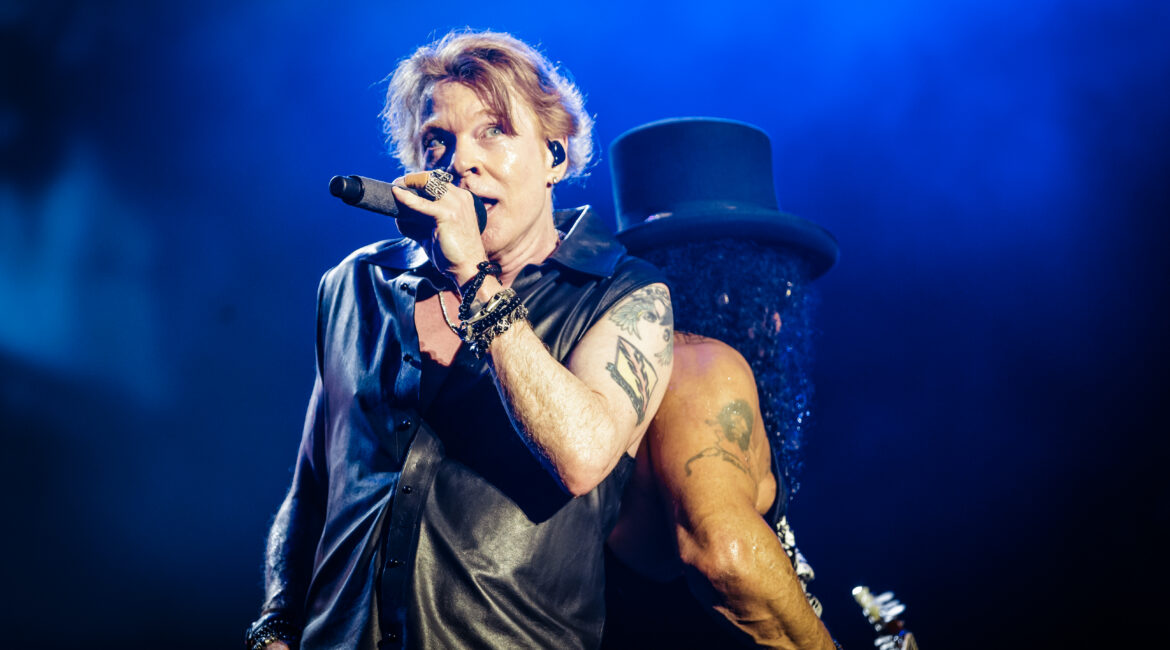
Axl Rose and Guns N’ Roses closed out the North American leg of their 2026 tour at Truist Park with nearly three hours of hits, deep cuts, guitar firepower and the kind of sprawling set that has come to define the band’s modern era.
There are few opening guitar chords in rock & roll that function quite like an alarm bell. The first notes of “Welcome to the Jungle” hit, Axl Rose lets loose that unmistakable howl, and suddenly it doesn’t matter that Appetite for Destruction came out nearly four decades ago. For the next few minutes, at least, it’s 1987 again.
At Truist Park in Atlanta on Saturday night, Guns N’ Roses didn’t ease into anything. “Welcome to the Jungle” opened a sprawling 25-song set that stretched more than two and a half hours, immediately followed by “Bad Obsession” and “It’s So Easy.” It was a statement of intent from a band that, even this far into its career, still understands the value of walking onto a stage and hitting an audience squarely between the eyes.
At the center, naturally, was Axl Rose, prowling the enormous stage, with frequent costume changes, working the ramps and delivering songs that remain among the most physically demanding in the classic-rock canon. Late in the evening Rose acknowledged that he was feeling under the weather, but by that point he had already spent hours attacking material that ranges from the low, menacing growl of “It’s So Easy” to the stratospheric demands of “Sweet Child O’ Mine.” The fact that the band still delivered 25 songs made the performance feel less abbreviated than defiant.
But the modern Guns N’ Roses is much more than the famous faces on the marquee. This is now a deeply seasoned live band, with musicians who have spent years — and in some cases decades — inhabiting this material together.
Richard Fortus has long since become one of the essential elements of the band’s sound. He is a spectacular guitarist, but what makes him so effective is not merely technique. Fortus plays with intensity, precision and a physical attack that gives the songs real momentum. His interplay with Slash is one of the great strengths of the current lineup: sometimes doubling, sometimes answering, sometimes pushing in a completely different direction, but almost always making the guitar arrangements feel wider and more alive. On songs like “Double Talkin’ Jive,” “Rocket Queen” and “Civil War,” the pleasure comes as much from hearing the guitarists respond to one another as from waiting for any single spotlight moment.
Dizzy Reed’s keyboards, piano and backing vocals are fundamental to the scope of the Use Your Illusion material. Songs such as “Estranged” and “November Rain” depend on atmosphere as much as volume, and Reed’s playing helps turn them from hard-rock songs into something cinematic. His presence is easy to overlook amid the guitars and pyrotechnics, but remove those textures and much of the grandeur disappears with them.
Duff McKagan remains the rhythmic backbone of the group, his bass playing carrying the punk edge that has always existed beneath Guns N’ Roses’ hard-rock exterior. That side of his musical personality came roaring forward when he took lead vocals on the Misfits’ “Attitude,” one of the evening’s most direct and joyful blasts of punk rock. Isaac Carpenter brought plenty of muscle of his own, driving a catalog whose grooves are every bit as important as its riffs. And then there is Slash, still one of rock’s great visual and musical signatures, but now operating within a guitar section that is strongest when it functions as a conversation rather than a showcase.
That was especially apparent throughout the first half of the show. “Mr. Brownstone” still swings in a way most hard-rock songs never learned to, while “Rocket Queen” remains one of the great demonstrations of how many different things Guns N’ Roses can be within a single song — sleazy, bluesy, atmospheric and ultimately soaring. “Pretty Tied Up” offered a welcome trip into the deeper corners of Use Your Illusion II, and “Yesterdays,” one of the band’s most underrated singles, felt especially appropriate coming from musicians with this much history behind them.
This wasn’t simply a greatest-hits exercise. Guns N’ Roses has increasingly treated its live catalog as something to explore rather than preserve under glass, and Atlanta offered some terrific examples. The band pulled out not one but two Black Sabbath songs: the wonderfully unexpected “Junior’s Eyes” and the immortal riff barrage of “Sabbath Bloody Sabbath.” Later came “Nothin’,” representing a band that continues to release and perform new material rather than relying exclusively on its past.
Then there are the songs that have become almost mini-productions of their own. “Live and Let Die” remains tailor-made for a stadium, its quiet opening verses exploding into one of the most gloriously excessive refrains in rock. “You Could Be Mine” still races forward with the combination of punk velocity and arena-rock muscle that made it such a natural fit for Terminator 2. “Double Talkin’ Jive” gave the guitarists room to stretch out, while the epic “Estranged” unfolded with the widescreen ambition of the Use Your Illusion era intact.
One of the more remarkable things about a modern Guns N’ Roses set is just how strange the musical journey can become without ever ceasing to sound like Guns N’ Roses. In the space of a single evening the band can move from the Misfits to Black Sabbath, from Paul McCartney to Velvet Revolver, then settle into “Wichita Lineman,” Jimmy Webb’s great American song forever associated with Glen Campbell. Somehow it works. Guns N’ Roses was always a much broader band than its early reputation suggested — equal parts Aerosmith, punk rock, Elton John, Queen, blues and the Rolling Stones — and the current lineup has the versatility to make that range feel natural rather than forced.
“Dead Horse” led into a huge “Civil War,” one of the evening’s dramatic high points, ending with a nod to Jimi Hendrix’s “Voodoo Child (Slight Return).” From there Slash stepped forward for his guitar solo, but even that moment felt less like a break from the band than another movement within the larger show. By this point, the cumulative effect of the night was not simply the star power of individual players but the sheer density of musicianship across the stage.
Later in the set, Atlanta got one hometown-flavored surprise when Carrie Underwood joined the band briefly for “Sweet Child O’ Mine” and returned for the finale, “Paradise City.” Her appearance gave the crowd an extra jolt, but the evening’s momentum belonged overwhelmingly to the band itself.
“November Rain” remained one of the show’s most expansive moments, with Rose at the piano and the band gradually building around him until the song reached its enormous final section. If “Welcome to the Jungle” represents the dangerous street-level Guns N’ Roses of Appetite, “November Rain” represents the opposite extreme: unapologetically enormous, romantic, theatrical and ambitious. The song works because the entire band understands how to manage that scale — Reed’s piano and keyboards, the rhythm section’s patience, the layered guitars and Rose’s vocal all pushing toward the same destination.
“Nightrain” then provided one last blast of Appetite for Destruction at full speed before the familiar opening of “Paradise City” announced the end. It was exactly the kind of finale a Guns N’ Roses show demands: loud, excessive and gleefully over the top, with the band accelerating toward the finish as Truist Park seemed to unload whatever energy it had left.
Nearly four decades after Appetite for Destruction transformed them from an L.A. club band into one of the biggest rock acts in the world, Guns N’ Roses remains an unusual proposition. This is not a tidy legacy act carefully reproducing old records. The shows are too long, the set lists too unpredictable and the musical detours too numerous for that. There are punk songs, blues jams, piano epics, deep cuts, covers, new material and enough guitar firepower to keep the air above the stage permanently electrified.
What Atlanta made especially clear is that the strength of Guns N’ Roses in 2026 lies not simply in nostalgia or in the presence of its most famous members. This is a band with extraordinary depth: Rose still throwing himself into some of the most demanding songs in rock, Slash and Fortus building a formidable two-guitar attack, McKagan anchoring the music with punk-bred authority, Reed adding the textures and scale that much of the catalog requires, and Carpenter driving it all from behind the kit. The names may carry history, but the band onstage is very much alive in the present, and Atlanta got nearly three hours of proof.